Device and Description

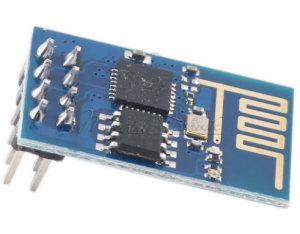
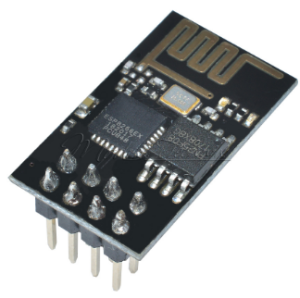
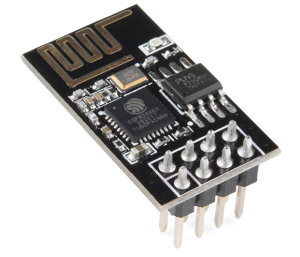
ESP8266 ESP-01 Serial WIFI Wireless Transceiver Wireless Module LWIP AP+STA

Devices

Description

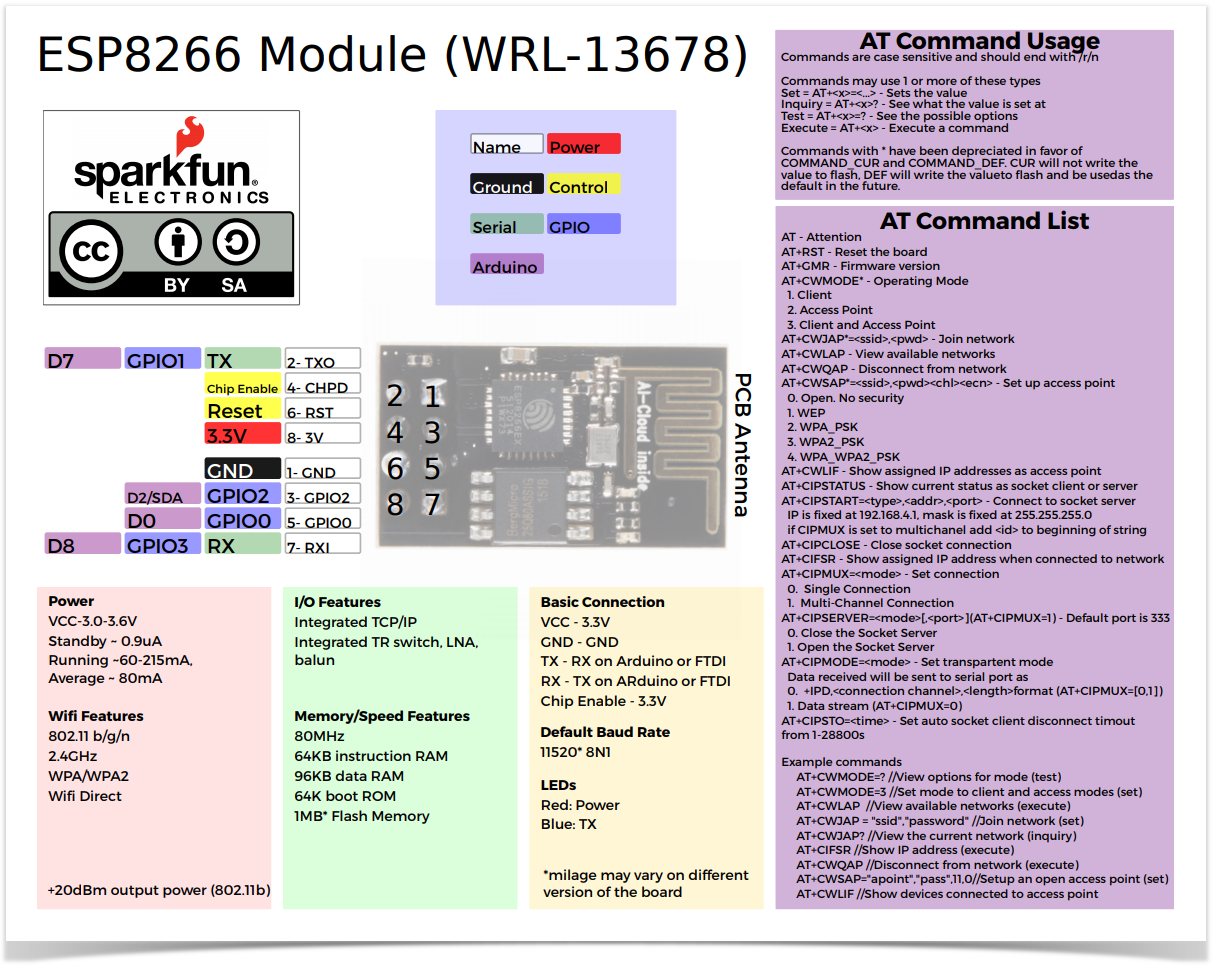
ESP8266 Module (WRL-13678)

  • 802.11 b/g/n
  • Wi-Fi Direct (P2P), soft-AP
  • Integrated TCP/IP protocol stack
  • Integrated TR switch, balun, LNA, power amplifier and matching network
  • Integrated PLLs, regulators, DCXO and power management units
  • +19.5dBm output power in 802.11b mode
  • Power down leakage current of <10uA
  • 512kB/1MB Flash Memory
  • Integrated low power 32-bit CPU could be used as application processor
  • SDIO 1.1 / 2.0, SPI, UART
  • STBC, 1×1 MIMO, 2×1 MIMO
  • A-MPDU & A-MSDU aggregation & 0.4ms guard interval
  • Wake up and transmit packets in < 2ms
  • Standby power consumption of < 1.0mW (DTIM3)


Datasheets and AppNotes

ESP8266-01

AddOns / Zubehör

Interconnection / Power Supply / Programming Interface

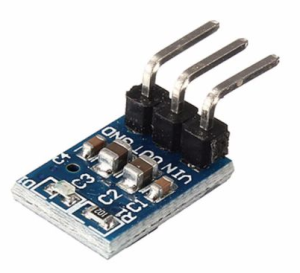
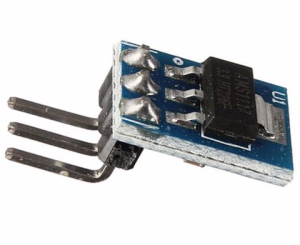
Spannungsregler 3.3V: AMS1117-3.3 3.3V

(Quelle: ebay, 13.06.2018, €1,00 / 5Stk.)

5PCS AMS1117-3.3 3.3V DC-DC Step-Down Power Module Buck Module LDO 800MA

EUR 1.--

Features:
Size:8.6mm x 12.33mm
Input voltage: DC 4.2 V-10 V
Output: 3.3 V, 800 mA

Description: 
1.Boost modules or buck module indicate the operating voltage, Please donot exceed operating voltage , or it will be damaged easily. 
2.Boost module output voltage can only be greater than or equal to input voltage, cannot be less than the input voltage. 
3.Buck module input voltage must be higher than output voltage of 1.5V or 2V, otherwise it can not output enough power. 
4.Automatic Adjustable Boost or Buck module has start voltage and limit working voltage, Please donot exceed them , or it will be damaged easily. 
5.Cannot reverse polarity , or it will be short circuit, or will be  born easily. 


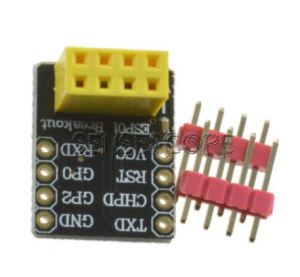
Breadboard Adapter for ESP8266 ESP-01 ESP-01S Wifi Transceiver Module Breakout

(Quelle: ebay, 13.06.2018, €1,00 / Stk.)

This is a breadboard adapter for the popular ESP-01 model of the ESP8266 serial-to-WiFi transceiver module. 
As ESP-01 Pin arrangements are not breadboard friendly and are not labeled, which makes it little inconvenient for rapid prototyping.This breadboard adapter will help you to make 
prototyping with esp-01 module much more easier.
This breakout conveniently offers clear pinout silkprint on top and will nicely fit your prefered breadboard.
Last but not least, we added a 0.1µF decoupling capacitor so the ESP-01 will always run smoothly and without a hitch.

Connection:

UART        Adapter
3.3V           VCC
3.3V           CH-PD
TX               RX
RX              TX
Choose both NL CR 15200 baud rate

Package Included:

  • 1 X ESP-01 Breakout Board Breadboard Adapter
  • 2 X 4P male header


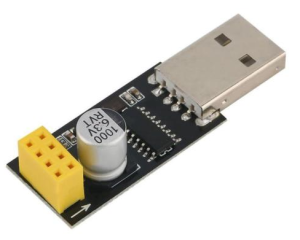
ESP8266 ESP-01 Flasher mod.prog, USB Programmer Uploader für Arduino IDE, IoT

(Quelle: ebay, 13.06.2018, €1,00 / Stk.)

This adapter board is mainly used to facilitate the ESP8266 through the serial port to connect PC.
Material Features:
1. Using CH340 to serial chip, stable performance, good compatibility, Windows system basically all support.
2. Adapter board integrated 1000uF solid capacitors to ensure that the current supply, not because of power problems so that WIFI module crash without response.
3. Using 3225 chip crystal, to enhance the stability of the serial port, and beautiful tall.

Package Include:
  • 1 × pcs

SPU:LPO3764


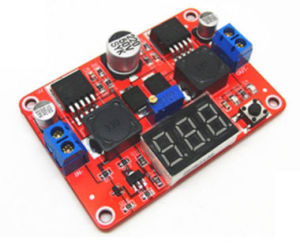
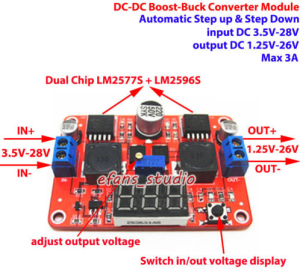
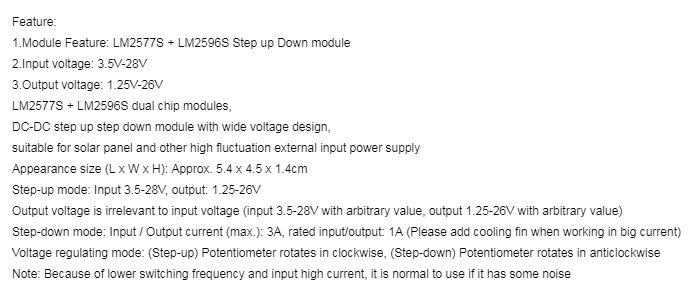
LED DC-DC Adjustable Boost Buck Step Up Down Converter 3.3V 5V 9V 12V 19V 24V 3A

(Quelle: ebay, 22.06.2018, €4,22 / Stk.)

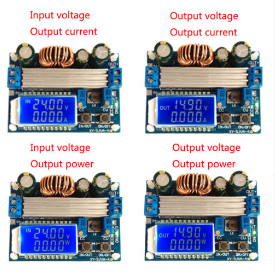
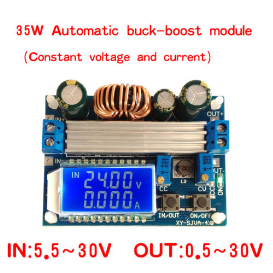
DC 5.5-30V to 0.5-30V 35W LCD Digital voltmeter ammeter adjustable buck boost

(Quelle: ebay, 22.06.2018, €5,15 / Stk.)


Buck-boost module (constant voltage constant current LCD version)
1. Product highlights:
1.1 LCD input and output voltage, output current output power;
1.2. Input anti-reverse protection, reverse connection will not burn;
1.3. Can be step-up and step-down, the output voltage 0.5-30V arbitrary regulation, limiting the current 0-4A arbitrary regulation;
1.4 output anti-intrusion, the battery charge without additional anti-reflux diodes;
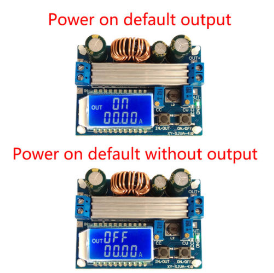
1.5. Button control output ON / OFF status, and you can set the power-on default is ON or OFF;
1.6. Ascending and descending chip used as the main controller, external 60V 75A MOS tube as a switch, double 60V 5A SS56 Schottky rectification, 60V voltage value, superior to the market immature XL6009 / LM2577 program (a lot Device pressure value is not enough, MOS tube and Schottky diode pressure value must be greater than the input plus input voltage value);
1.7. Output ripple small, LC filter;
1.8. With heat sink, send module support isolation column.

2. Product parameters:
Input voltage: 5.5-30V (input voltage 5V, you can normally achieve buck-boost, but the voltage and current meter values are not accurate; less than 4.7V, undervoltage protection)
Output voltage: 0.5-30V
Output current: long-term stable work in 3A, strengthen the heat can reach 4A
Output power: 35W natural cooling, heat dissipation to enhance 50W
Voltage display resolution: 0.05V
Current display resolution: 0.005A
Conversion efficiency: about 88%
Soft-start: Yes (very powerful with load startup, startup may fail)
Input reverse protection: Yes
Output anti-intrusion: Yes
Short circuit protection: yes
Working frequency: 180KHZ
Size: L * W * H 66 * 48 * 21mm
Mounting hole: 4mm in diameter
Weight: 46g

3. Function Description:
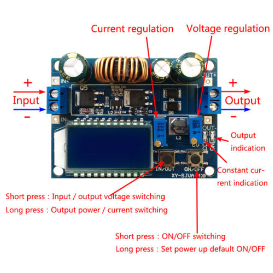
3.1. Module has IN / OUT, ON / OFF two buttons: IN / OUT button to switch the input voltage and output voltage display, long press to switch the output current output power display; ON / OFF button control output ON or OFF, long press Set power on default output status is ON or OFF.
3.2.CC is the current setting potentiometer, clockwise rotation, can increase the set current, when the load current reaches the set current, enter the constant current state, CC constant current indicator (red) lights up; the right CV is the voltage setting Potentiometer, clockwise rotation, can increase the output voltage. ON indicator is the output status indicator, when the output voltage is on, otherwise off.

4. How to use:
4.1. Used as an ordinary buck-boost module with over-current protection capability
(1) Adjust the CV constant voltage potentiometer so that the output voltage reaches the voltage you want.
(2) Measure the output short-circuit current with 10A current meter (connect the two test leads directly to the output end), and adjust the CC constant current potentiometer to make the output current reach the preset over-current protection value. (For example, if the current value displayed by the multimeter is 2A, the maximum current will only reach 2A when you use the module. When the current reaches 2A, the red constant voltage and constant current LED is on, otherwise the LED is off)
Caution: When using in this state, there will be a voltage drop of 0 ~ 0.2V due to the current sampling resistor at the output. At the same time, the input and output leads will have a certain linear voltage drop This is a normal phenomenon!
4.2. Used as a battery charger
Without constant current function of the module can not be used to charge the battery, due to the power of the battery and the charger pressure drop is large, resulting in charging current is too large, causing damage to the battery, so the beginning of the battery to use constant Flow charging, when the charge to a certain extent automatically switch back to constant voltage charging.
(1) Determine the float voltage and charging current for which you need the rechargeable battery (if the lithium battery parameter is 3.7V / 2200mAh then the float voltage is 4.2V and the maximum charging current is 1C, ie 2200mA)
(2) Under no-load condition, the multimeter measures the output voltage and adjusts the constant voltage potentiometer so that the output voltage reaches the float voltage. (If the 3.7V lithium battery is charged, adjust the output voltage to 4.2V)
(3) Measure the output short-circuit current with 10A current meter (directly connect the two test leads to the output terminal), and adjust the constant current potentiometer so that the output current reaches the predetermined charge current value;
(4) Connect the battery, charging.
(Steps 1, 2 and 3 are as follows: input termination power supply, the output is not connected to the battery load)
4.3. Used as LED constant current driver module
(1) Make sure you need to drive the LED operating current and the maximum operating voltage;
(2) Under no-load conditions, the multimeter measures the output voltage and adjusts the constant voltage potentiometer so that the output voltage reaches the maximum operating voltage of the LED.
(3) with a multimeter 10A current measurement output short-circuit current, while adjusting the constant current potentiometer so that the output current reaches the predetermined LED operating current;
(4) connected to the LED, test machine.
(Steps 1, 2, and 3 are as follows: Input the power and output the no-load LED.)
Note: This module is more than 3A, 35W use, please strengthen the heat! ! !

5. Note:
5.1. Module input IN- Prohibit short circuit with output OUT-, otherwise constant current function will be invalid.
5.2. Please make sure that the power of the power supply is greater than the power required by the output load!
5.3. If the module is to be fully loaded with output, the input voltage should be over 8V. When the input voltage is 5V, the output power is about 15W, and the voltage ammeter fails. Module current value 4A, the premise subject to the maximum output power, such as the output 17V, the current should not exceed 2A.
5.4. Module with output short-circuit protection, short-circuit protection module automatically shut down the output, the module can be restored on the power, if your power supply without output current limiting protection, it is recommended that the module input front-end fuse in series to increase the safety factor.
5.5. The module has input under-voltage protection function, the default is about 4.7V. Below this value, the output will be disconnected automatically and the module can be powered on again (note the voltage at the module port. When the input current is relatively large Do not ignore the partial pressure on the input wire).

Sensors

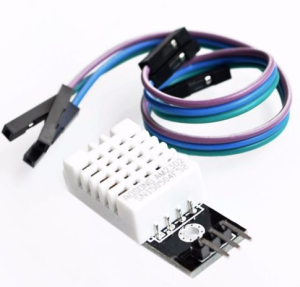
DHT22/AM2302 Digital Temperature And Humidity Sensor Module Replace SHT11 SHT15

(Quelle: ebay, 13.06.2018, €2,77 / Stk.)

Type:AM2302
Accuracy resolution:0.1
Humidity range:0-100%RH
Temperature range:-40~80?
Humidity measurement precision:±2%RH
Temperature measurement precision:±0.5?
ultra-low power
No additional components
excellent long-term stability
All calibration, digital output
completely interchangeable
long distance signal transmission
relative humidity and temperature measurement.


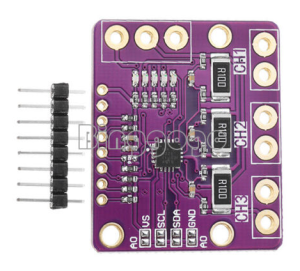
INA3221 3 Channel Shunt Current Voltage Monitor Sensor Replace INA219 Module

(Quelle: ebay, 22.06.2018, €2,38 / Stk.)


Description

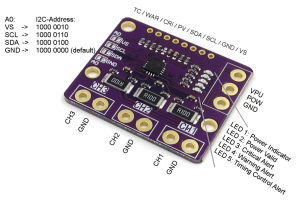
The INA3221 is a three-channel, high-side current and bus voltage monitor with an I2C- and SMBUS-compatible interface. The INA3221 monitors both shunt voltage drops and bus supply voltages, in addition to having programmable conversion times and averaging modes for these signals. The INA3221 offers both critical and warning alerts to detect multiple programmable out-of-range conditions for each channel.
The INA3221 senses current on buses that can vary from 0 V to 26 V. The device is powered from a single 2.7-V to 5.5-V supply, and draws 350 µA (typ) of supply current. The INA3221 is specified over the operating temperature range of –40°C to +125°C. The I2C- and SMBUS-compatible interface features four programmable addresses.

Features

  • Senses Bus Voltages From 0 V to 26 V
  • Reports Shunt and Bus Voltage
  • High Accuracy:
    • Offset Voltage: ±80 µV (max)
    • Gain Error: 0.25% (max)
  • Configurable Averaging Options
  • Four Programmable Addresses
  • Programmable Alert and Warning Outputs
  • Power-Supply Operation: 2.7 V to 5.5 V

https://os.mbed.com/users/anti007/code/INA3221/

Anderes Board, gleicher Chip:

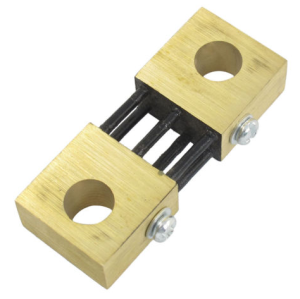
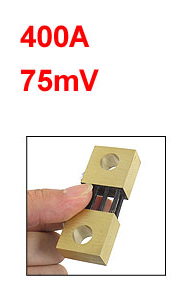
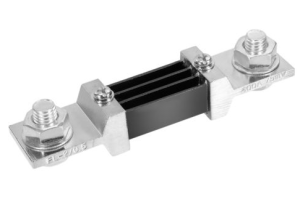
Metall Shunt Widerstand für DC 400A 75mV Amperemeter Analogschaltung Ausschuss (question)

(Quelle: ebay, 22.06.2018, €5,59 / Stk.)

Technische Daten

Produktname: Shunt Widerstand
Material: Metall
Modell: FC-1
Farbe: Gold Ton
Strom: 400A
Spannungsabfall: 75mV
Dimension: 64 x 25 x 13mm / 2.52" x 0.98" x 0.51"(L*W*T)
Nettogewicht: 117g
Lieferumfang: 1 x Shunt Widerstand

Beschreibung:

  • FC-1, Typ, bewertet 400A, Strom, Spannung 75mV bewertet, gold Ton Metall Material.
  • Der Splitter kann den hohen Strom direkt übergeben.
  • Messbereich von Amperemeter aufwenden kann verwendet werden. DC-Amperemeter und Splitter werden zusammen verwendet.
  • Gute Qualität, gute Leistung und einfache Installation.


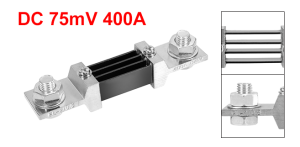
400A 75mV DC Gleichstrom Analog Panel Meter Shunt Widerstand für DC Amperemeter

(Quelle: ebay, 22.06.2018, €10,72 / Stk.)


Beschreibung

Der Shunt-Widerstand ist ein Gerät, das dem DC-Amperemeter zur Messung von hohem Strom helfen kann. Technisch muss ein Shunt parallel zum Amperemeter geschaltet werden (Stromteilung in Parallelschaltung)
Der Shunt-Widerstand hilft dem Strommesser, den Großteil des Stroms zu umgehen. Basierend auf dem Prinzip des Ohmschen Gesetzes könnte der Strom durch ein DC-Amperemeter berechnet werden, wenn ein Shunt die Spannung absenkt.Wenn es irgendwelche Herausforderungen gab, könnten Sie verwirrt werden. (Z. B. Schaltplan) Unser technisches Support-Team würde sich freuen, Sie zu unterstützen.

Feature:

  • Nennstrom: 400A
  • Spannungsabfall: 75 mV
  • Gewicht: 234g / 8.3oz
  • Länge: 125 mm / 4,9 Zoll
  • Modell: FL-2
  • Genauigkeit: 0,5
  • Country of Manufacture CHINA
  • Material Plastic,Metal
  • Net Weight 234g
  • Package Content 1 x Shunt Resistor
  • Model FL-2
  • Style 400A


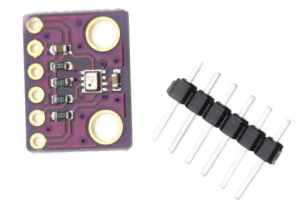
BMP280-3.3 Atmospheric Pressure Sensor Temperature Humidity Sensor Breakout Card

(Quelle: ebay, 22.06.2018, €2,38 / Stk.)

Beschreibung:

Größe: 1.52 * 1.20cm
BMP280-3.3 Hochpräzises atmosphärisches Drucksensormodul
Es ist toll für alle Arten von Wettererfassung und kann sogar in I2C und SPI verwendet werden.


Links und Anleitungen

Getting started: http://stefanfrings.de/esp8266/

Tutorial Arduino-IDE: https://iot-playground.com/blog/2-uncategorised/38-esp8266-and-arduino-ide-blink-example

Anwendungsbeispiele: https://www.forward.com.au/pfod/ESP8266/GPIOpins/ESP8266_01_pin_magic.html

Beispielapps:

Bezugsquellen